Native iOS • iPhone

Predicting
the unpredictable.

There are no universal migraine triggers. Migraine Navigator is an on-device personal forecast assistant that learns your unique migraine profile to help you plan ahead with confidence.

Requires iOS 17 or later • Free beta testing
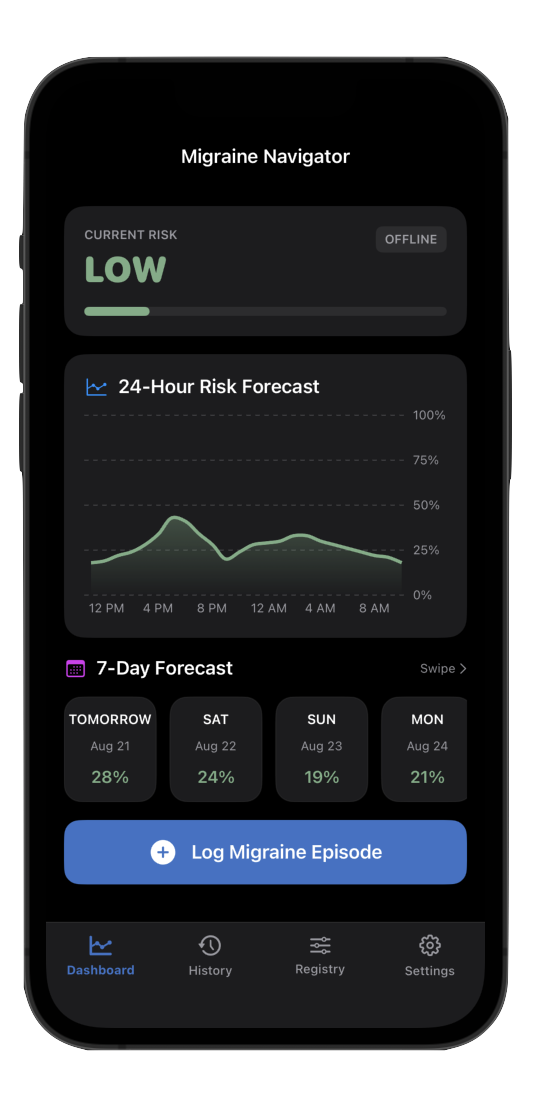
Migraine Navigator Dashboard on iPhone showing 24-hour hourly risk forecast and 7-day forecast cards

Key Features

24-Hour Risk Curve

Calculates an hourly breakdown of your migraine vulnerability window throughout the day, helping you schedule activities and manage stress.

Multi-Day Forward Forecast

Multi-day projections (with extended 10-day forecasts in Pro) let you plan ahead around your historical patterns and upcoming weather shifts.

Fast, Tap-Based Logging

Record pain levels (0 to 10), personal triggers, and acute medications in seconds, with zero unnecessary screens or complex questions.

Doctor Consultation Exports

Generate clean, structured log exports of your attack frequency, durations, triggers, and medication history to bring directly to your medical appointments.

Automatic Apple Health Integration

Reads available health metrics (such as sleep duration, resting heart rate, and daily activity) to build context without requiring manual entry.

Calm, Photophobia-Friendly Interface

High-contrast, zero-animation dark design crafted specifically for comfortable use during both pain-free days and active migraine attacks.

From a spreadsheet to on-device forecasting.

I've had migraine for a very long time, but it was never a major concern for me until I went off to my first year of university. Right then, after years of regular, sporadic migraine, I was thrust into the difficult job of managing chronic migraine, mostly on my own, in an unfamiliar environment.

My physicians highly recommended I keep a migraine log to track severity progression over time, maybe to see if certain medications were effective or certain triggers could be elucidated. Being an analytical thinker, I was not content with just tracking date, time, and severity, and I spent hours and hours building a way to track my migraines using the only tool I had at the time, which was a spreadsheet on my computer. I had heard about apps that would serve as a companion for people with migraine, and I did look into them, but I was not at all satisfied. Why should I make an account and accept my data being offloaded to who-knows-where just to log my own health condition?

That spreadsheet method allowed me to collect years of my own history, but I still felt it was too limited, too isolated. I was clearly missing an entire world of data that would be impossible to manually record in a spreadsheet.

Then, I learned about machine learning and, more importantly, how to implement it. I had an epiphany.

Up to that point, all of my detailed, near-obsessive tracking had been backward-looking. It told me where I had been in pain, but gave me very little help in planning for tomorrow and the rest of my week. Machine learning offered a way to turn years of historical logs into forward-looking foresight by learning the complex patterns unique to my own physiology.

I built Migraine Navigator to provide that foresight without the privacy trade-offs of modern commercial apps, and I want to offer this to you and every person living with migraine. Everything computes locally on-device, giving you personalized daily risk forecasts while keeping your personal health records entirely in your own hands.

Aresh Tajvar Creator & Developer, Migraine Navigator

Privacy is the architecture, not just a feature.

No personal health records, symptoms, triggers, medications, or identifying information ever leave your device except through explicit, user-initiated actions (such as exporting a CSV file, sharing a physician report, or backing up via private iCloud).

Read the Privacy Policy →
On-Device Processing No User Account Zero Data Tracking

Important Medical Notice

Migraine Navigator is designed solely for informational and educational purposes. This product is not intended to diagnose, treat, cure, or prevent any disease. Risk forecasts and projections do not guarantee the occurrence or absence of an attack. Always seek the advice of your physician or other qualified healthcare provider before making any medical decisions or changes to your treatment plan.